


National Geographic 1998 November
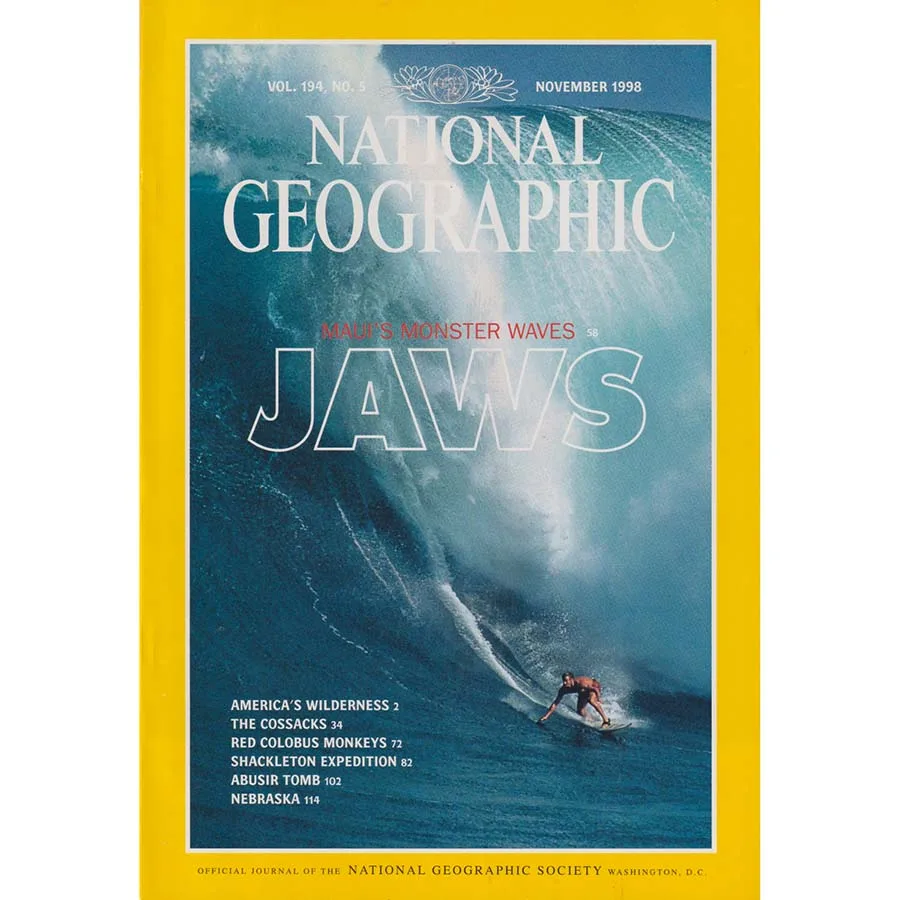
Publisher: National Geographic
Format: Paperback
ISBN: none
National Geographic, November 1998: the issue that looks you dead in the eye and says, “So… you still think you’re in control?” Then it puts a human being the size of a punctuation mark on the face of a moving mountain of water and titles the whole experience JAWS—because apparently the ocean also gets branding.
This is peak late-90s Nat Geo energy: a glossy, calm, beautifully typeset reminder that the planet can end your confidence in a single, foamy shrug. The cover is basically a motivational poster for humility. One surfer, one wave, and a whole lot of “I should have stayed home and reorganised my socks.”
Inside, it’s not just surf-terror. It’s a full buffet of “the world is large and you are a guest”:
-
Maui’s Monster Waves – adrenaline tourism for people who think gravity is a polite suggestion. Nat Geo gives you the physics, the bravado, and the quiet question: why would anyone do this on purpose?
-
America’s Wilderness – a loving portrait of open spaces, wild creatures, and the unspoken fact that civilisation mostly exists because wilderness is inconvenient to pave.
-
The Cossacks – history with boots on. Horseback identity, hard borders, harder reputations, and enough romantic legend to make you forget it involved a lot of mud and not much central heating.
-
Red colobus monkeys – adorable, endangered, and tragically stuck in the part of the story where humans are still doing “development” like it’s a contact sport.
-
Shackleton expedition – the gold standard in “bad travel choices that became inspirational.” Nothing says leadership like calmly improvising survival while Antarctica tries to delete you.
-
Abusir tomb – a reminder that ancient Egypt perfected two things: monumental architecture and the long, serene commitment to outlasting everyone who ever doubted you.
-
Nebraska – the perfect curveball. After monster waves, polar endurance, and tombs built for eternity, Nat Geo lovingly zooms in on a place many people can’t point to on a map… which is precisely why it’s in here, quietly insisting that “ordinary” is just “unexamined.”
The irony of this issue is that it sells awe in two speeds. One minute you’re clinging to your armchair as Maui tries to turn a surfer into a rumour. The next, you’re in Nebraska, where the drama is subtle, the horizons are long, and the existential dread is more of a gentle prairie breeze. Nat Geo doesn’t judge. It simply documents the fact that the planet offers both: sudden chaos and slow-burn wonder. (And you will be moved by both, because the photos are unfairly good.)
Condition: Good, which is also the emotional state you’ll be in after reading it—good, a little shaken, slightly wiser, and newly aware that water, ice, history, and monkeys are all doing their own thing regardless of your plans.
Perfect for anyone who enjoys:
-
nature as a beautiful threat,
-
history with grit under the fingernails,
-
exploration as a series of deeply questionable decisions,
-
and a magazine that can take you from “GIANT WAVE PANIC” to “Nebraska, actually” without blinking.
Sold by Crappy Old Books, which feels thematically appropriate: this is a time capsule from when the world was still “big” in print, and fear came with captions and a reassuring yellow border.
Keep browsing: See more National Geographic books Other books by National Geographic
